

AI is moving at an Exponential Rate #
Wow! It’s just been a few weeks, and so much has been going on in the world of AI that I’m having a hard time trying to think of a single topic to cover. There are some obvious trends in the tooling you should be using to code, but lets talk a bit about how we get ahead of what’s coming.
Instead of talking about what capabilities may become, let’s explore the reality that we’re getting agents SUPER cheap right now, and that’s not going to last.
Recommended Article: The True Cost of AI when Subsidies Run Out
The best AI Harness/Code Combos #
The two top-dogs in AI coding at the moment are Claude Code and Open AI’s Codex. There is no doubt that both of these harnesses and the associated models are unbeatable by anything running on consumer grade GPUs/NPUs.
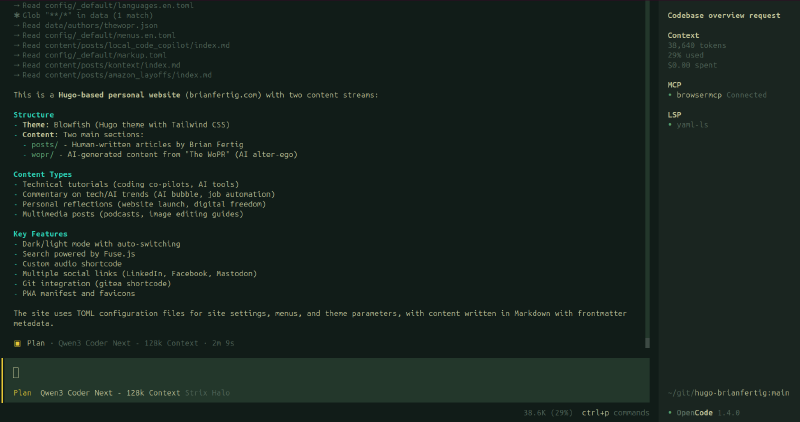
That being said, there are Open Source alternates to these behemoths, and the my favorite Open Source harness is OpenCode. You can back-end OpenCode with several really nice capable Open Source models, and many Large LLM Open Source models are given away for free for limited periods of time as a way to test model strength in the wild, or to hopefully get you hooked. You can connect to many different providers, including local providers.
It is important, I believe, not to become dependant on anything as-a-service #
One of the beliefs I have had my entire career is that I don’t want to get hooked on tools that I can’t own. I’m completely fine, and even prefer, full subscription models at the office, but for my personal knowledge, capabilities and growth I won’t become dependant on a tool or service.
The reasons are simple:
- After an initial market share phase, prices often go up (think cable, netflix, etc.)
- In the world of AI, the amount of venture capital subsidizing the market means this will be 1000x worse than we’ve seen before when it happens.
- Tiered Plans ($20/month or $100/month etc.) often experience queues, or tighter usage restrictions to offset increasing costs and demand.
- If you give over back-end setup and infrastructure to any XaaS provider, you rob yourself of the knowlege of understanding how everything works and you become less important to the process.
Using Multiple Harnesses to code with AI #
I believe that Anthropic’s Claude is the absolute best harness/model combo out there. Both Sonnet 4.6 and Opus 4.6 are absolutely incredible when combined with Claude’s TLI. Nothing comes close when it comes to either setting up the initial structure of a project, or taking existing code and hitting it with a major refactor.
Opus is the most expensive model-per-token, followed by Sonnet 4.6. What many Claude subscribers have been doing is starting up projects with Sonnet or Opus and then switching over to Haiku (the cheap model) once things are rolling. And that’s a good strategy if you want to stay in that ecosystem.

Coders must learn to pick the ‘right’ intelligence #
One of the emerging skills in modern software development is likely to be when to use what for development – it makes zero sense to use Sonnet or Opus for minor tweaks or basic troubleshooting. Everyone who codes needs to get good at understanding exactly how much intelligence is needed for the task at hand. This will especially become important as we move out of the Market Share Phase of AI development and the true costs of generation becomes the consumers obligation. (Trust me developers – at some point the bills you generate will be part of your “performance review”).
What I have been doing, is starting up with Sonnet (or in some cases Opus) and getting my initial project framework in place, then switching to local models and OpenCode to put together features, enhancements, troubleshooting and polish. Believe it or not, local gen consumer grade GPU/NPU can keep up well with a project once it’s off the ground.
What Hardware am I using? #
My local setup includes the following services and hardware on my home network:
- Dockerized front-end of Open WebUI which allows me to give models basic system prompts and temperature/top_p/top_k/etc. settings, and has an Open AI compatible API which I can connect to from other software.
- PC with an RTX 5090 GPU - 32GB VRAM using Ollama on Windows 11 to serve models. Models that fit inside 32GB of VRAM and leave enough room for a good context window absolutely fly on a 5090. If you want a 10-30B parameter model’s worth of intelligence – this is hands down the way to go, it’s lightning fast.
- Models I’m currently using include: Gemma 4 31B, QWEN 3.5 27B and 9B
- A GMKtec EVO-X2 AI-Max+ 395 Strix Halo - 128GB Unified Memory with Lemonade Server on Ubuntu to serve models. Similar to a DGX Spark but at half the price, this is the beast of the setup. Inference is slower, but you can fit large 120B+ models onto this machine with a ton of room for context.
- Models Im currently using include: QWEN Coder Next, GPT-OSS-120B, QWEN 3.5 128B-A10B
What have I been creating? #
Here are a few projects I’ve built in the last few weeks, with a combination of the tools mentioned above, and with locally generated AI graphics and AI music.
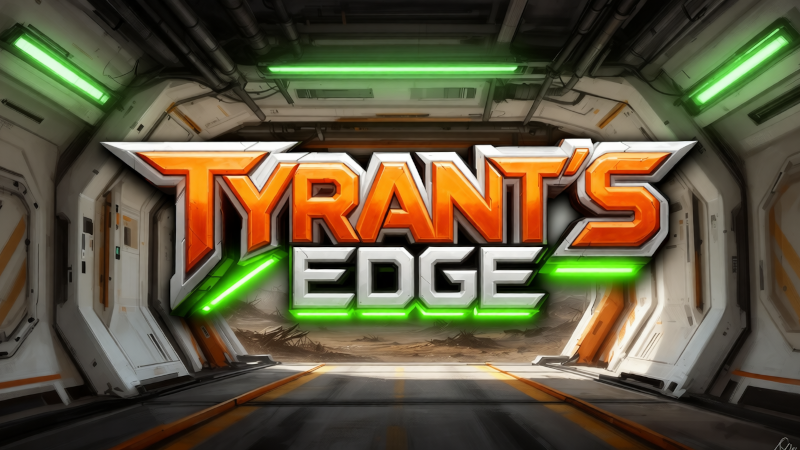
Tyrant’s Edge - Card Battle Game #
I wanted to create something that had a lot of complexity, orchestration and a need to understand balance of strength in order to create a game that would have deep strategy. A collectable card battling game seemed like just the trick. This game is really fleshed out with 5 factions of cards, each with strengths and weaknesses, a campaign and many many interactive elements.
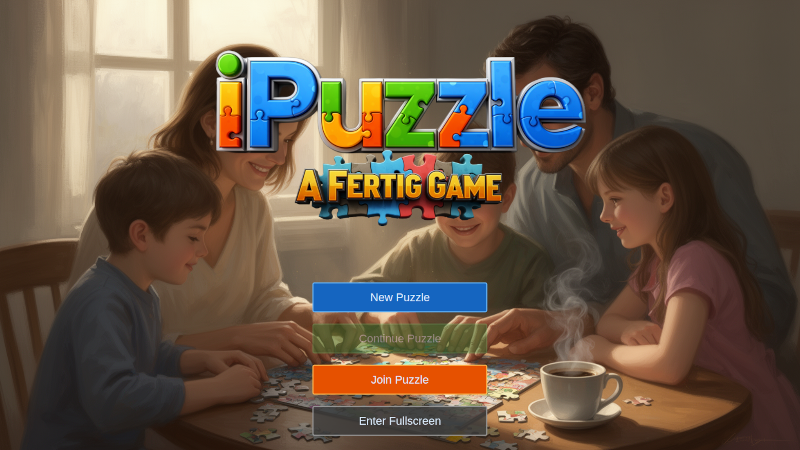
iPuzzle - Multiplayer Jigsaw Puzzles #
I wanted to create a multiplayer game. This game is all about the relaxing time spent putting together jigsaw puzzles with family and friends. Players can pick a jigsaw puzzle to complete, and a room code and invite links are generated. Players can complete the puzzles together, earning achievements and seeing each other interacting with pieces.
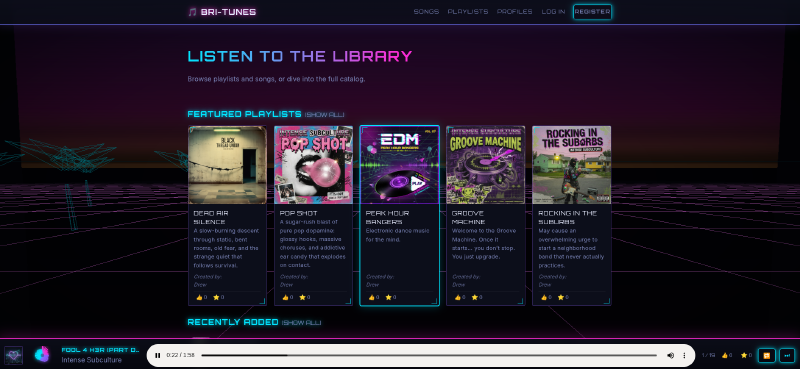
brI-Tunes - A Music Portal #
brI-Tunes is my personal take on something like Soundcloud. I have been generating (and training) a lot of AI music lately, and wanted a place to share this with friends, co-workers and family. This site allows anyone to create an account, upload music and share playlists. This site is all about AI music and creating a fun way to listen and share.